New data sets added to our researcher database
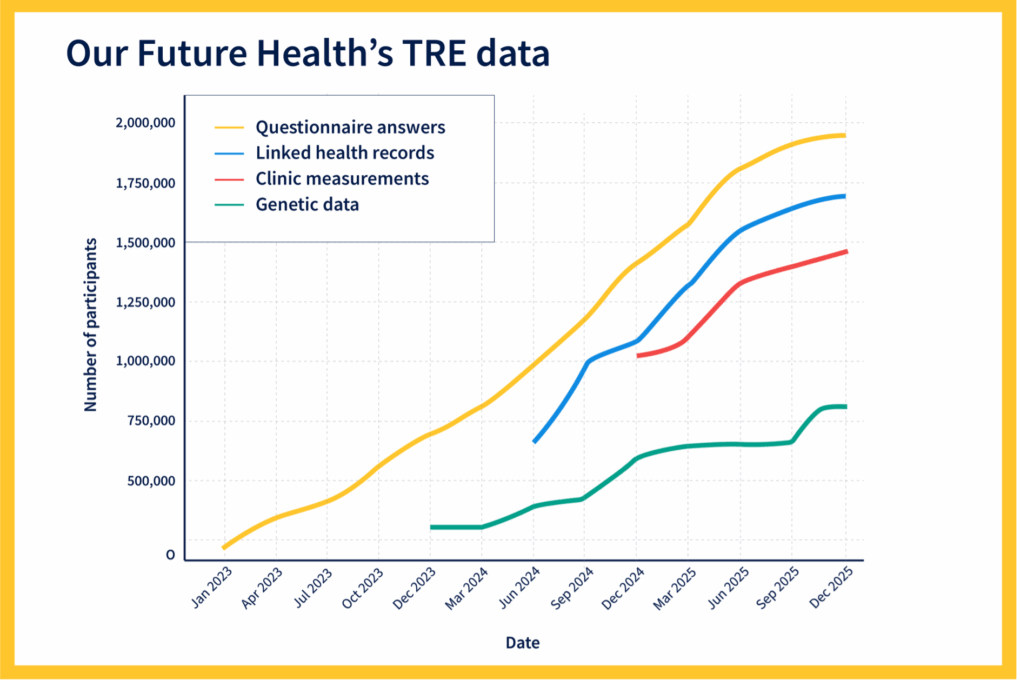
Every three months, we release new data into our trusted research environment (TRE) – a secure computing environment in which registered researchers can conduct approved studies.
Our latest data release took place last week – and it’s a major one. We’re excited to announce that we’ve added or enhanced 4 key data sets. The TRE now contains:
- Imputed genotype data, for the first time
- Dispensed medicines data, for the first time
- More granular geographical data
- Improved emergency care data
The new data provides registered researchers with greater resolution that will further catalyse health discoveries. It is set to dramatically expand the possibilities of the Our Future Health research programme.
Imputed data for 159 million variants
We’ve massively expanded the depth of our genetic data by releasing an imputed set that increases the number of variants for each participant from 700,000 to 159 million.
New opportunities for researchers include increasing statistical precision to discover genetic drivers of disease and potential therapeutic targets, as well as an increased ability to predict disease.
Medicines dispensed in primary care
Registered researchers can now apply to access data on medicines that have been dispensed – not just prescribed – in primary care in England.
This is the first time that dispensed medicines data have been available to health researchers at this scale alongside other detailed cohort data, providing a unique opportunity for registered researchers.
The data will enable researchers in pharmacogenomics and pharmacoepidemiology to study drug effects on health outcomes with greater accuracy, as well as the biology and epidemiology of medicines and their role across health services.
Geographical data for 1.8 million participants
We’ve added country and region data at the point of registration for 1,841,458 participants. We’ve also introduced new location variables to our data, including Lower Super Output Areas (LSOA) and Middle Super Output Areas (MSOA) for England and Wales, and Intermediate Zones for Scotland.
This finer level of detail has a vast number of epidemiological research applications, such as estimating disease risk and incidence, and understanding the impact of deprivation on health outcomes.
Improved emergency care data
Finally, we’ve expanded our emergency care data by adding details such as which ambulance trust responded, and when the call was made. The data can be used to help studies on ambulance performance and support commissioners in planning regional resources.
What the new release means for researchers
These new data sets unlock bold new research possibilities – as our Director of Science and Biostatistics, Dr Ben Cairns, explains:
“Our latest data release opens up rich new opportunities for researchers by adding the first large-scale data sets of imputed genotypes. We’ve also added small-area geographic information, linkage to medicines dispensed in primary care, and improved emergency care data.
“The release marks another step-change in the capabilities of the Our Future Health resource. It will enable ambitious new studies in genetics, pharmacoepidemiology, environmental health and many other fields.”
Our TRE – in numbers
This is the 13th data release since we began adding data to our TRE in January 2023.
As well as our new and enhanced data sets, we’ve released new participant data into our TRE. Here’s a snapshot of the types of data in our TRE, and the number of volunteers for each category, as of 11 December 2025:
| Data type | Number of volunteers in our TRE |
| Answers to our health and lifestyle questionnaire | 1,929,752 |
| Geographical data | 1,841,458 |
| Genetic data | 775,118 |
| Imputed data | 550,000 |
| Clinic measurements | 1,456,410 |
| Linked health records | 1,690,845 |
Live studies in our TRE
Our volunteers’ data is already being used by health researchers to find new ways to prevent, detect and treat diseases.
You can read more about this in the following features:
- Professors Frank Kee and Amy Jayne McKnight: ‘Our Future Health’s data will help to deepen our understanding of health inequalities’
- Dr Mahantesh Biradar: What it’s like to be an Our Future Health researcher
To see a full list of approved studies that are analysing Our Future Health’s data, visit the Health Data Research Gateway.